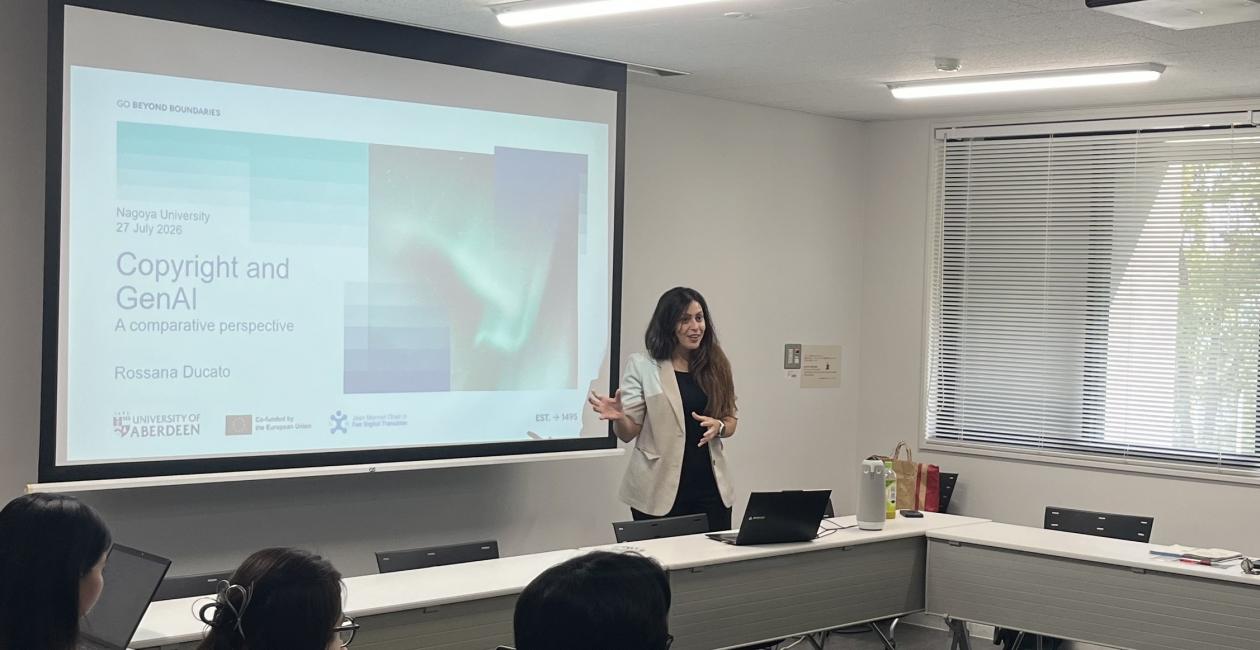
On 27 July 2026, the Graduate School of Law, Nagoya University, welcomed Dr. Rossana Ducato, Senior Lecturer in IT Law and Regulation at the University of Aberdeen School of Law (UK), for a guest lecture entitled “Copyright and Generative AI: A Comparative Perspective.” The lecture examined how the rapid development of generative artificial intelligence (GenAI) is reshaping copyright law across different jurisdictions, with a particular focus on the European Union, the United Kingdom, and Japan.
The lecture began with a review of the fundamental principles of copyright law. Dr. Ducato explained that copyright protects the original expression of ideas rather than the ideas themselves, and grants authors both moral and economic rights. She also introduced the concept of copyright exceptions and limitations, including text and data mining (TDM), teaching, research, and other public interest uses. These exceptions have become increasingly important in the context of AI development.
The second part of the lecture focused on how copyright issues arise at different stages of building an AI model, namely data collection, model training, and content generation. In particular, Dr. Ducato highlighted three major legal questions surrounding the use of copyrighted works as training data: (1) whether AI models reproduce copyrighted works; (2) whether AI-generated outputs may infringe existing copyrights; and (3) whether AI-generated outputs are copyrightable.
Subsequently, Dr. Ducato introduced the different approaches adopted by various jurisdictions to the first issue, namely whether AI models reproduce copyrighted works during training. In Japan, Article 30-4 of the Copyright Act provides a relatively broad exception for text and data mining when the purpose is not to enjoy the expressive content of copyrighted works. In contrast, the European Union distinguishes between research-related TDM and commercial TDM, while allowing copyright holders to opt out of certain uses. The United Kingdom adopts a more limited exception for non-commercial research.
The lecture also examined whether AI-generated outputs are copyrightable. Dr. Ducato explained that, under the current approaches in the EU and Japan, copyright generally requires sufficient human creativity. AI-generated works created through simple prompts alone are unlikely to qualify for protection, whereas works produced through substantial human creative input may still satisfy the originality requirement. She also discussed the UK's unique provision on computer-generated works and recent proposals to reconsider its future.
Copyright law is entering a period of significant transformation. The lecture provided participants with a timely overview of one of the most rapidly developing areas of contemporary intellectual property law. Through comparative analysis and discussion of recent cases, it encouraged participants to think critically about how existing copyright frameworks can respond to technological innovation while maintaining an appropriate balance between the interests of creators, AI developers, and the public.
This special lecture is a part of the “Lawyer Training Program for Globalization,” funded by a donation from the Shinnippon-Hoki Foundation.