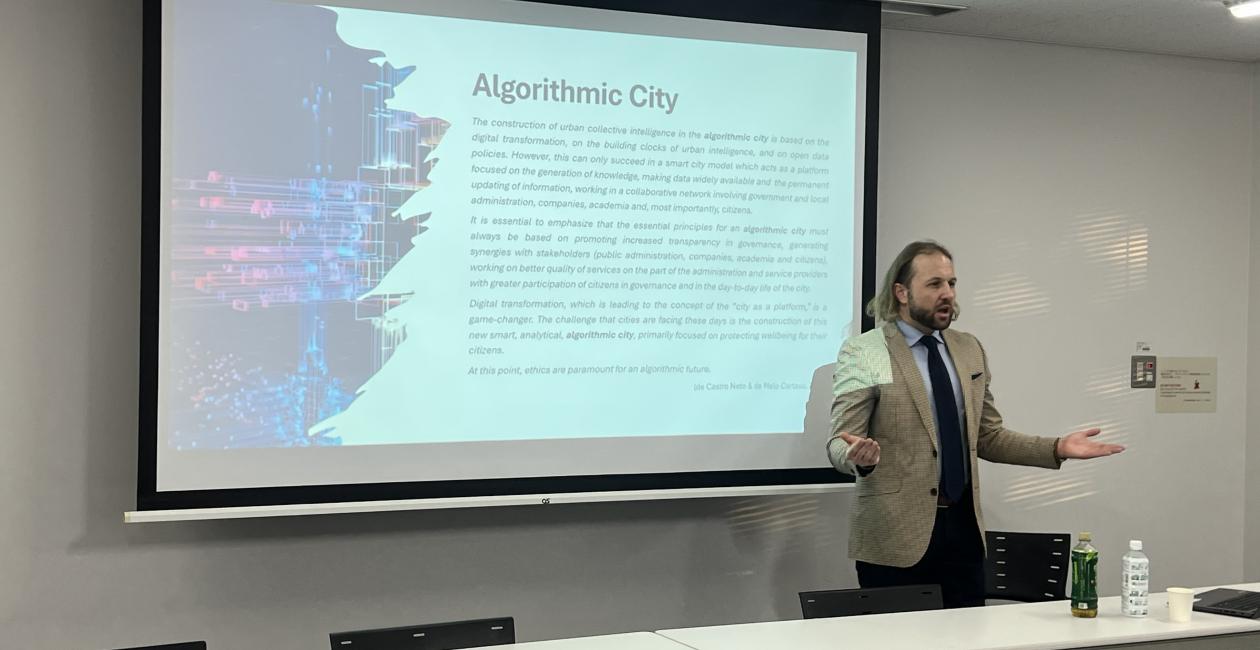
On February 12, 2026, the Graduate School of Law at Nagoya University had the privilege of hosting Associate Professor Dr. Hab. Maciej M. Sokołowski, Specially Appointed Associate Professor at the Faculty of Policy Management, Keio University. He delivered a special lecture titled “Bricks, Bytes, and Bylaws: Re-Writing Law for Algorithmic Cities.”
The lecture explored the transformative impact of artificial intelligence and digital infrastructures on contemporary urban governance. Professor Sokołowski opened his presentation by explaining how rapid urban digitalization is reshaping cities into what he described as “algorithmic cities.” These are complex ecosystems in which AI systems, automated decision-making, and data-driven technologies increasingly regulate public services, mobility, housing, energy distribution, and civic administration. He emphasized that this evolution goes beyond the traditional “smart city” paradigm and signals a deeper structural transformation of urban life.
A central theme of the lecture concerned the adequacy of existing legal frameworks. Professor Sokołowski critically examined whether traditional municipal bylaws are capable of regulating algorithm-driven infrastructures. He explained that these bylaws were historically grounded in physical urban planning and analog governance processes. He discussed the need for proactive and adaptive regulatory approaches. He proposed multi-layered governance models that integrate supranational standards, national legislation, and flexible municipal regulations.
The lecture further addressed hybrid regulatory solutions designed to balance technological innovation with fundamental democratic values. Professor Sokołowski highlighted the importance of transparency, accountability, non-discrimination, and public participation in the governance of algorithmic urban systems. He underscored that safeguarding these principles is essential as cities become increasingly dependent on automated technologies.
The session concluded with an engaging question-and-answer segment. Participants discussed the future role of lawmakers, urban planners, engineers, and citizens in shaping legal frameworks for human-algorithm coexistence in rapidly evolving urban environments.
This special lecture is a part of the “Lawyer Training Program for Globalization,” funded by a donation from the Shinnippon-Hoki Foundation.